


How We Test & Score Our Mattresses
Finding the right mattress is one of the most important decisions you can make for your sleep quality — and one of the hardest to get right. A mattress in a store might feel completely different after a full night of sleep. A mattress online gives you nothing to go on but photos and marketing copy. That’s why, at Best Sleep Society, we built a testing process that takes the guesswork out of mattress shopping entirely.
Every score on Best Sleep Society is built on real, hands-on mattress testing — not guesses, not sponsored content, and not a five-minute sit on a showroom floor. We test each mattress across 8 performance categories: cooling, pressure relief, motion transfer, response, edge support, off-gassing, bounce, and company. Each category is weighted by its impact on your sleep experience, with scores rounded to one decimal place.
Here’s exactly how we test mattresses, why each category matters, and what the scores actually mean.
Our Scoring System
Before getting into the categories, it helps to understand how our scoring system works. Every mattress receives an overall score that is a weighted average of its 8 category scores. The weights reflect how much each factor actually impacts your sleep experience night after night:
- Cooling — 20%
- Pressure Relief — 20%
- Motion Transfer — 15%
- Company — 15%
- Bounce — 10%
- Response — 10%
- Edge Support — 5%
- Off-Gassing — 5%
No single category makes or breaks a mattress. A good mattress performs consistently across all categories — and our scoring system is designed to reflect that.
Cooling (20%)
Why It Matters
Trapped heat is one of the most common complaints among mattress owners — and one of the most underrated factors in sleep quality. If a mattress retains your body heat through the night, your core temperature rises, your sleep cycles become shallower, and you wake up more often. A good mattress manages heat actively, not passively.
Memory foam mattresses in particular have historically struggled with cooling. Dense foam layers trap heat more easily than open-cell foam or hybrid constructions with individually wrapped coils, which allow for more airflow. Memory foam has improved significantly in recent years — but it still varies widely between models, which is exactly why we test it.
How We Test It
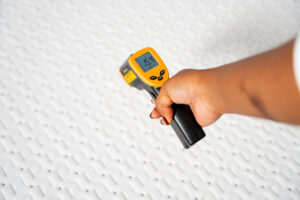
We measure the baseline surface temperature of each mattress before any contact. A test participant then lies on the mattress for 10 minutes. After they get up, we record the surface temperature at 1, 2, 3, 4, and 5 minutes to build a heat retention curve. Results are analyzed and scored out of 10.
This approach gives us a precise picture of how each mattress handles body heat over time — not just whether it feels cool to the touch.
What a High Score Means
A high cooling score means the mattress surface returns to near-baseline temperature quickly after contact. For hot sleepers or anyone in a warm climate, this is one of the most important scores to prioritize.
Pressure Relief (20%)
Why It Matters
Pressure relief is arguably the most important performance category for sleep quality. When a mattress doesn’t adequately cushion your body’s pressure points — hips, shoulders, knees, lower back — your muscles stay partially tensed through the night, restricting circulation that fragment your sleep.
The stakes are especially high depending on your sleeping position. Side sleepers put significant pressure on the hip and shoulder, making a good pressure relief score critical for avoiding hip pain and shoulder discomfort. Back sleepers need support that keeps the spine in a neutral position without creating pressure at the lumbar curve. Even stomach sleepers, though we generally advise against that position for spinal alignment, benefit from a mattress that doesn’t create excessive pressure at the chest and pelvis.
Body shape also plays a major role. Heavier body types compress foam layers more deeply, shifting pressure distribution differently than lighter sleepers. Our testing accounts for this by evaluating mattress materials and construction with a range of body types in mind.
How We Test It
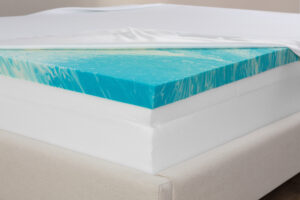
Our team of mattress designers and sleep experts examines the construction of each mattress in detail, with a focus on how it responds to key pressure points across different sleeping positions. We look at comfort layer thickness and foam density, how the mattress responds under concentrated load, and whether the construction supports spinal alignment in side sleeping, back sleeping, and combination sleeper positions.
This is a qualitative assessment — because pressure relief is fundamentally about human experience, and no instrument fully captures it. Our experts bring years of hands-on experience evaluating mattress materials, foam layers, and support systems to every pressure relief score.
What a High Score Means
A high pressure relief score means the mattress cushions your body’s pressure points effectively across different sleeping positions without sacrificing support. For side sleepers, back sleepers, and anyone dealing with hip pain or chronic discomfort, this is the score to watch.
Motion Transfer (15%)
Why It Matters
If you share a bed, motion transfer can make or break your sleep experience. A mattress with poor motion isolation transmits every movement — a partner rolling over, getting up in the night, or shifting positions — directly across the sleep surface. Sensitive sleepers in particular feel this acutely.
All foam mattresses and memory foam mattresses tend to perform best on motion isolation, because foam absorbs movement rather than transmitting it. Hybrid mattresses with individually wrapped coils perform well too, since each coil moves independently. Traditional innerspring mattresses, with their interconnected coil systems, typically score lower here.
How We Test It
We place a calibrated accelerometer on one side of the mattress while a test participant lies and moves naturally on the other side. We record the full range of movement — rolling, shifting, getting up — and measure exactly how much motion reaches the accelerometer. The more movement recorded, the lower the motion transfer score.
This is one of our most objective mattress testing methods. The data is clean, numerical, and directly comparable across every mattress we test.
What a High Score Means
A high motion transfer score means the mattress absorbs movement effectively, keeping disturbance on your side of the bed to a minimum. For couples or anyone who shares a bed with a restless partner, this score matters enormously.
Response (10%)
What a High Score Means
A high response score means the mattress springs back quickly. This is most important for combination sleepers and anyone who tends to change positions frequently through the night. It also reduces that “stuck” feeling that some people find disruptive.
Why It Matters
Response describes how quickly a mattress springs back to its original shape after compression. A mattress with slow response can feel like it “cradles” you in place — which some sleepers love, but which makes it harder to change positions through the night. For combination sleepers who move between back sleeping, side sleeping, and other positions, good response is essential.
Extremely soft, high-density memory foam mattresses tend to have the slowest response. Latex and hybrid mattresses typically respond more quickly. The right balance depends on how much you move in your sleep and how you feel about that “cradled” sensation.
How We Test It
We place a 15 lb medicine ball on each mattress, allow it to reach maximum sinkage, then remove it and time how long the mattress takes to return to its original shape. This test sinkage and recovery sequence is repeated consistently across every mattress we evaluate, making results directly comparable.
What a High Score Means
A high response score means the mattress springs back quickly. This is most important for combination sleepers and anyone who tends to change positions frequently through the night. It also reduces that “stuck” feeling that some people find disruptive.
Edge Support (5%)
Why It Matters
Edge support is often overlooked in mattress reviews — but it has a real impact on sleep experience and daily usability. Weak edges reduce your usable sleep surface, since sleeping or sitting near the perimeter risks a sudden sinking sensation. Strong edge support means you can use the full width of the mattress without feeling like you’re about to roll off.
Edge support also affects how easy it is to get in and out of bed — important for back sleepers, older adults, and anyone with mobility concerns. When a mattress sinks dramatically at the edge, sitting up and standing becomes harder and less stable.
All foam mattresses tend to have softer edges than hybrid models, which typically use reinforced perimeter coils for a firmer feel at the edge. We test edge support separately from the main comfort testing to get a clean, isolated measurement.
How We Test It
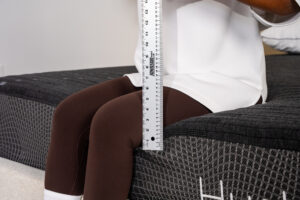
We measure the mattress height before and after a test participant sits on the edge. The difference in height — how much the mattress sinks under that concentrated weight — determines the edge support score.
To test edge support properly, we use the same participant across all mattresses to control for body weight, and we test at a consistent point along the mattress perimeter.
What a High Score Means
A high edge support score means the mattress holds its shape well under perimeter load. For couples who need to use the full width of the bed, or anyone who struggles with getting in and out, a strong edge support score is worth prioritizing.
Off-Gassing (5%)
Why It Matters
Off-gassing is the chemical smell released by a new mattress — particularly common with all foam mattresses and memory foam mattresses, which are manufactured using chemical compounds that can take time to dissipate. For most people, it’s a temporary inconvenience. For sensitive sleepers, it can be genuinely disruptive and may cause headaches or irritation during the first days of use.
Mattress smell intensity and duration varies widely. Some mattresses air out within a few hours; others can retain a noticeable odour for several weeks. The difference often comes down to foam density and the specific materials used in the comfort layer and support core.
How We Test It
Our off-gassing score is a subjective assessment based on how long it takes for any noticeable odour to fully disappear after unboxing the new mattress. Testers evaluate odour intensity at regular intervals until it’s no longer detectable.
This is an intentionally qualitative measure — because the experience of a mattress smell is a sensory human judgment, not a number on a sensor. We believe this gives a more useful assessment than instrument-based measurements that don’t capture how the smell actually affects a real person sleeping in the room.
What a High Score Means
A high off-gassing score means the mattress has little to no noticeable odour, or that any smell dissipates quickly. For sensitive sleepers or anyone setting up a new mattress in a smaller room, this score is worth checking.
Bounce (10%)
Why It Matters
Bounce reflects the energy a mattress returns when compressed — and it affects several dimensions of sleep experience. A bouncier mattress is easier to move around on, making it more suitable for combination sleepers. It also tends to feel more “on top of” the mattress rather than “in” it — a preference that varies significantly between sleepers.
Latex mattresses and hybrid models with individually wrapped coils tend to score highest on bounce. Memory foam mattresses, by contrast, absorb energy rather than returning it, which contributes to their low-bounce, high-cradling feel. Neither is inherently better — it depends entirely on what you want from your sleep experience.
How We Test It
We drop a 15 lb medicine ball from exactly 2 feet above the mattress surface and use a slow-motion camera to precisely measure both maximum sinkage depth and maximum bounce height. The difference between sinkage and bounce height determines the score. A higher bounce height relative to sinkage earns a higher score.
The medicine ball is dropped from the same height and position for every mattress we test, making results directly comparable across the full range of mattress materials and constructions.
What a High Score Means
A high bounce score means the mattress returns energy well and has a responsive, “on top of” feel. This is most relevant for combination sleepers, couples, and anyone who prefers ease of movement over a deep-cradling feel.

Company (15%)
Why It Matters
The mattress itself is only part of what you’re buying. The brand behind it — its shipping policies, return process, trial period, and warranty — determines your actual experience as a customer. A good mattress from a brand with poor policies can still be a bad purchase. And a genuinely customer-first brand makes the entire process of buying, testing, and potentially returning a mattress far less stressful.
This section is scored out of 10 across three sub-categories.
Shipping, Returns, Options & Perks (40% of Company Score)
There are many factors that affect your decision to purchase a mattress. We award brands 1 point for each of the following qualifications:
- Made in Canada. We’re a Canadian-based company and we support local brands. Domestic manufacturing is more sustainable and supports the Canadian economy.
- Available to purchase in Canada. Our readers need access to the mattresses we review.
- Free shipping. A meaningful perk given how large a mattress purchase already is.
- Ships in a box. Easier and more convenient delivery for everyone.
- The company picks up returns. Customers shouldn’t have to wrestle a mattress out the door.
- Full refund upon return. Free returns are non-negotiable.
- Availability. 1 point for full availability (in-store, retailer, and online). 0.75 points for retailer + online or in-store + online. 0.5 for only one channel.
- Multiple firmness levels. 1 point per firmness level available. (Example: 3 firmness levels = 3 points.) Mattress firmness variety is important because the right firmness for a side sleeper is very different from what a back sleeper or stomach sleeper needs.
Trial Period (30% of Company Score)
Trials are essential. A mattress in store tells you almost nothing about how that mattress will feel after a week of actual sleep. A good trial period gives you real time — in your own bed, in your own sleeping position — to decide whether a mattress is right for you. It also reduces the risk of a blind purchase on a mattress online.
| Trial Length | Points |
| 365+ nights | 10 |
| 200-364 nights | 9 |
| 100-199 nights | 8 |
| 50-99 nights | 5-7 |
| Less than 50 nights | 0-4 |
Warranty (30% of Company Score)
A warranty is key when buying a mattress — but the fine print matters enormously. Many brands use long headline warranty numbers to imply better long-term durability coverage than the policy actually provides. Hidden conditions can void your warranty for common issues like normal indentation depth, use without a specific foundation, or failure to rotate the mattress on a set schedule.
We read through every warranty policy and identify the hidden conditions that are designed to limit your actual coverage. That analysis is factored directly into the warranty score.
Pre-Score by warranty length:
| Warranty Length | Pre-Score |
| More than 15 years | 9-10 |
| 10-14 years | 7-8 |
| Less than 10 years | 5-6 |
Final Warranty Score = (Pre-Score + Deal Score) / 2
The Deal Score reflects our qualitative assessment of the actual conditions, exclusions, and gotchas in the warranty policy. A 20-year warranty with aggressive exclusions will score lower than a 15-year warranty with genuinely fair terms.
How to Properly Test a Mattress
Formal testing like ours isn’t available to most consumers — but there are things you can do to properly test a mattress yourself, especially during a trial period.
Test it in your actual sleeping position. Don’t just lie on your back for a few minutes. Spend time in the positions you actually sleep in. If you’re a side sleeper, spend time on your side. Pay attention to whether you feel pressure at the hip or shoulder, and whether your spine feels like it’s in a neutral position.
Give it time. A new mattress can feel different in the first few nights as it breaks in and as your body adjusts. Don’t make a final judgment after a single night.
Test edge support. Sit on the edge of the bed. Does it sink dramatically? Try sleeping near the edge. A mattress that sinks too much at the perimeter reduces your usable sleep surface significantly.
Pay attention to how you feel in the morning. Hip pain, shoulder discomfort, lower back stiffness, or numbness in the limbs after waking are all signs a mattress may not be providing the right pressure relief and spinal alignment support for your sleeping position and body type.
Check for off-gassing. When your new mattress arrives, unbox it in a well-ventilated room and let it air out before sleeping on it. Note how strong the smell is and how quickly it dissipates.
A Note on Our Process
Our testing process is thorough, but we’re human. Mattress scores are based on real, hands-on mattress testing and careful analysis — but occasionally a test may be executed imperfectly, a score miscalculated, or a policy update missed. We check and double-check our work to keep errors to a minimum, but they can happen.
Our goal is always to give you the most honest, accurate mattress reviews and test results possible — so you can make a confident, well-informed decision without having to take our word for it blindly.
If something doesn’t look right, reach out. We take our testing process seriously, and we’re always working to make it better.